It has always been my desire to write about this subject. When I started my first blog, I had many thoughts that I wanted to share. However, due to a lack of time and other priorities, I stopped writing and eventually quit blogging. Today, I have decided to return—not because I have more time, but because I do not want these thoughts to disappear into the clouds of life, only to be replaced by newer ones. Every meaningful thought deserves to be preserved, expressed, and shared. Perhaps a single idea, woven into words with honesty and compassion, can nourish someone else’s mind and inspire positive change. The topic I want to explore is “Kali.”In India, the name Kali immediately reminds us of Maa Kali, one of the most powerful and revered forms of the Divine Feminine. She symbolizes strength, courage, justice, and the destruction of evil.
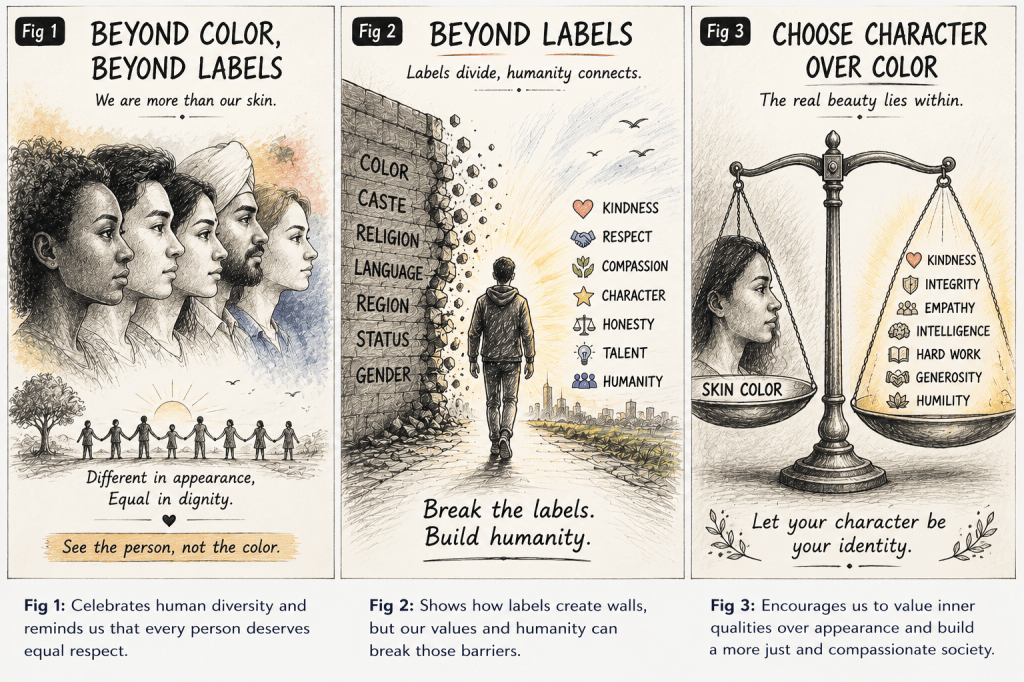
Yet, outside this spiritual context, the word kali is often casually associated with dark skin and, unfortunately, is sometimes used to judge, stereotype, or even ridicule people. This raises an important question: Why do we still allow color to influence our perception of a person’s worth? Despite all our social progress, education, and technological advancement, people continue to be categorized by their appearance, caste, religion, language, region, or social background. Sometimes these judgments are obvious, while at other times they remain hidden behind polite words and social behaviour. Whether it is skin color, caste, religion, or community, many people still experience unequal treatment because of labels that have nothing to do with their character, ability, or humanity. It is worth reflecting on our own cultural and spiritual heritage. In Hindu tradition, Lord Krishna is lovingly described as Shyam—the dark-complexioned one. Many artistic and literary traditions also describe Lord Rama as having a dark or dusky complexion. Maa Kali herself derives her name from her dark appearance, yet she is worshipped as the embodiment of supreme power, protection, and compassion. These examples are not presented to compare religions or cultures, but to remind us that our own traditions have long celebrated divinity beyond physical appearance. Yet, in everyday life, we often fail to extend the same respect and acceptance to our fellow human beings. This issue is not merely an idea; it is something we witness almost every day. When a baby is born, one of the first questions many people ask is, “Is the baby fair or dark?” Before asking whether the child is healthy, we unknowingly begin evaluating appearance.As children grow, many hear comments such as, “You would look more beautiful if you were a little fairer.” These words may appear harmless, but they slowly influence confidence and self-worth. The same mindset often appears while searching for a life partner. Even today, in many families and matrimonial discussions, complexion is sometimes mentioned before qualities such as education, kindness, honesty, compassion, or values. Shouldn’t character always come before color? For many years, advertisements, films, and television also promoted fair skin as the standard of beauty, especially for women. Thankfully, this perception is gradually changing, and many talented artists are challenging these stereotypes. Yet the old mindset still survives in countless homes and conversations. The truth is that discrimination rarely begins with actions.It begins with a thought.A silent thought. A hidden thought. Most of us know that judging someone because of their appearance is wrong. Yet many of these thoughts remain buried in the darkest corners of our minds. We may never express them openly because we fear criticism or social rejection, especially in today’s world where opinions spread rapidly through social media. But silence does not erase prejudice—it only hides it. Our hidden thoughts shape our hidden behaviour. That is why the real darkness is not someone’s complexion. The real darkness is the prejudice that silently lives within us. This issue is not confined to India alone. Across the world, people have faced discrimination because of the color of their skin. History has witnessed slavery, segregation, apartheid, and powerful movements against racial discrimination. Humanity has made remarkable progress, yet prejudice still finds new ways to survive. Perhaps the greatest battle today is not against darkness outside us, but against the darkness within our own thinking.
Where Do We Begin?
Changing society is a long journey, but every journey begins with a single step. If prejudice is learned, then acceptance can also be learned. Perhaps we can begin with a few simple yet meaningful changes:
1. Examine our own thoughts. Before judging anyone, ask yourself: “Would I think the same if this person’s complexion, surname, religion, or social background were different?” Self-awareness is the first step toward change.
2. Stop casual comments about appearance. Phrases like “You are dark,” “You would look better if you were fair,” or jokes about complexion may seem harmless, but they can leave lifelong emotional scars.
3. Raise children without prejudice. Children are not born discriminating against others. They learn from the conversations, jokes, and attitudes they observe at home. Let us teach them to admire honesty, kindness, courage, and character more than appearance.
4. Value character above appearance. Whether choosing friends, employees, students, or life partners, let integrity, compassion, capability, and values become our first criteria—not skin color or social labels.
5. Challenge stereotypes respectfully. When we hear discriminatory remarks in our families, workplaces, or social circles, we need not argue aggressively. Sometimes a simple question—”Why should color matter?”—is enough to make people reflect.
6. Celebrate diversity instead of comparing it. Nature itself is beautiful because of its diversity. Flowers bloom in different colors, yet none is superior to another. Humanity is no different.
7. Practice equality in everyday life. Equality is not demonstrated only through speeches or social media posts. It is reflected in how we speak to people, how we treat colleagues, domestic workers, neighbours, strangers, and those whose backgrounds differ from our own.8. Remember our spiritual values. If we truly believe that every human being is created with dignity, then no person’s worth can be measured by complexion, caste, religion, or social status. Our actions should reflect the values we claim to believe in.Real transformation will not happen overnight. But if each of us removes even one prejudice from our own mind, society will become kinder for someone else. It begins with appreciating kindness, integrity, intelligence, generosity, and humanity more than outward appearance. Children are not born with prejudice. They learn it from the world around them. Let us ensure they learn acceptance instead. Before allowing a thought about someone’s appearance to grow in our minds, let us pause for a moment and ask ourselves:”Am I judging this person for who they are, or merely for how they look?” Every prejudice begins as a seed. If we allow it to grow, it becomes discrimination. If we remove it while it is still a seed, it can never become injustice. Perhaps the real darkness is not in a person’s complexion but in the prejudice that clouds our minds. True progress will come not when we merely speak about equality, but when we practice it—in our homes, schools, workplaces, friendships, and everyday interactions. May be it is time to see people not by the color of their skin, but by the light of their character. Before I conclude, I would like to leave you with one final thought. Every prejudice begins as a thought. If we nurture that thought, it slowly becomes a belief. A belief shapes our behaviour, and repeated behaviour eventually becomes a social norm. That is how discrimination survives—not because everyone openly supports it, but because too many of us silently accept it. The darkness that humanity should fear is not the darkness of skin; it is the darkness of prejudice. If we truly wish to build a kinder and more just society, the change must begin with us. It begins in our homes, in the values we teach our children, and in the respect we show to every individual, irrespective of complexion, caste, religion, language, gender, or social background. Humanity should always weigh more than appearance. This article is only the beginning of a much deeper conversation. In the second part of this series, we will discuss something that is often invisible but deeply painful—the mental harassment and emotional suffering caused by prejudice and unfair treatment. We will explore how repeated comments, rejection, stereotypes, unconscious bias, and social discrimination silently affect confidence, self-esteem, relationships, and mental well-being. These wounds are often invisible, but for many people they last a lifetime. If we can understand the pain caused by our words and behaviour, perhaps we can begin to change not only ourselves but also the society we leave for the next generation. Until then, before forming an opinion about someone’s appearance, pause for a moment and ask yourself: “Am I seeing this person through my eyes, or through my prejudice?” Perhaps that one honest question is where real change begins.


Leave a Reply